As an Amazon Associate we earn from qualifying purchases. Learn more.
Patio Umbrella Bases: Sand vs Water vs Concrete for Winter Stability (2026)
Late-season gusts can send a freestanding patio umbrella tumbling. This guide compares three real-world anchoring approaches — a permanent in-ground steel concrete holder and two concrete-weighted freestanding bases — to help you pick the most stable option for winter winds. You’ll learn which fill/material types hold best in storms, how mobility vs permanence affects stability, and the trade-offs in installation and longevity. Products were selected from reliable outdoor-umbrella designs with clear customer feedback on sturdiness, ease of installation, and durability.
Quick Answer
For the most winter stability choose the Lifeswell Universal In-Ground Umbrella Base (B0DLSNYW78) — a permanent, steel concrete holder that resists tipping in strong winds. If you need a heavy but movable freestanding base, the VredHom 43lbs Premium Base with wheels (B0DHXJ4FQH) is the best portable option.
Our Top Picks
Quick Comparison
Select 2-3 products to compare side-by-side
| Compare | Product | GardenVerve Score | Price Tier | Key Feature | Best For | Action |
|---|---|---|---|---|---|---|
 Lifeswell In-Ground Base |
Budget | Permanent in-ground steel holder | Homeowners wanting permanent wind resistance | Check Price | ||
 VredHom 43lbs w/Wheels |
Premium | Built-in wheels for easy movement | People who want heavy stability plus mobility | Check Price | ||
 VredHom 43lb Concrete |
Mid-Range | Classic heavy concrete freestanding base | Buyers wanting simple heavy freestanding stability | Check Price |
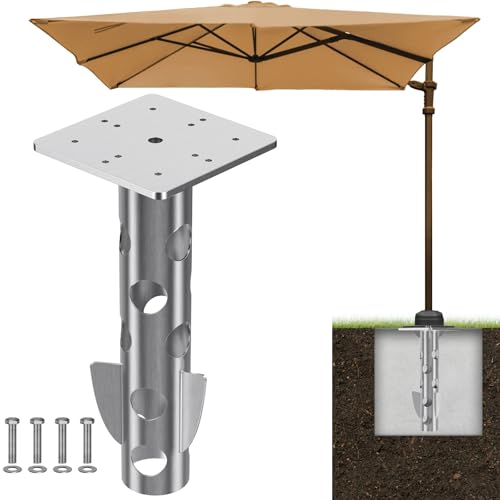
1. Universal In-Ground Umbrella Base, Rust-Resistant Steel Concrete Holder, Space-Saving Design for Outdoor Offset Cantilever Upright Umbrella Stand
A space-saving, permanent steel insert set into poured concrete for maximum anchoring. Designed for offset cantilevers and upright umbrellas, it trades portability for superior hold in strong winds and late-season storms.
Key Specs
- Material: High-strength welded steel (plated)
- Depth: 16-inch grounding depth, requires 18" x 18" x 18" hole
- Compatibility: 3 sets of rectangular holes (3/4/4.5 in.) for various poles
- Installation: Set into poured concrete
Pros
- Provides stronger permanent anchoring than freestanding concrete bases
- Saves surface space and reduces tripping hazards compared with bulky bases
- Generally praised for sturdiness, fit, and build quality
Cons
- Requires digging and concrete — not portable or renter-friendly
- Rust resistance reported mixed by some customers compared with coated steel options
Best For: Homeowners wanting permanent wind resistance
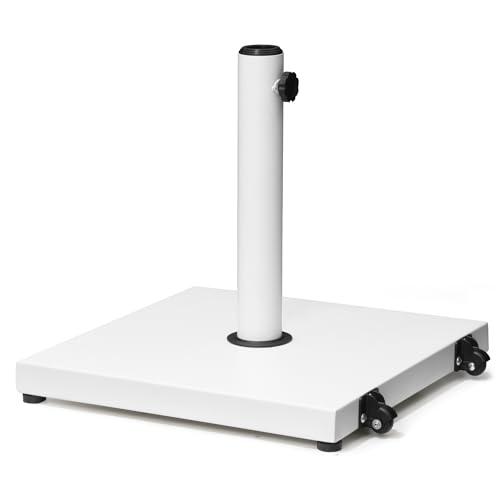
Check Latest Price on Amazon2. Patio Umbrella Base 43lbs Outdoor Umbrella Stand with Wheels, Heavy Duty Square Concrete Stand Market Umbrella, White
A heavy, powder-coated steel and cement square base that balances weight with mobility thanks to integrated wheels. Good match when you want a substantial freestanding anchor but still need to move the umbrella occasionally.
Key Specs
- Material: Powder-coated steel shell with cement fill
- Weight: 43 lbs (pre-filled concrete construction)
- Compatibility: 3 open cap sizes for 1 3/8", 1 1/2", 1 8/9" poles
- Features: Upgrade wheels for easier movement
Pros
- More mobile than Lifeswell thanks to wheels, while still heavier than many freestanding bases
- Looks and finish receive positive comments compared with plain concrete blocks
- Versatile collar sizes fit most market umbrella poles
Cons
- Wheels are plastic — less robust than all-metal alternatives and noted by some customers
- Heavier and bulkier than water/sand-fill options, so not ideal for daily relocation
Best For: People who want heavy stability plus mobility
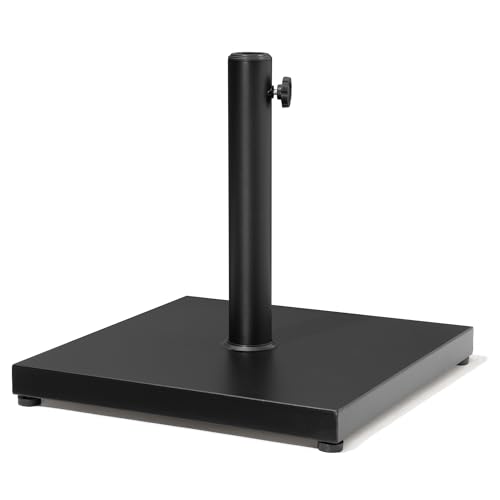
Check Latest Price on Amazon3. 43lb Patio Umbrella Base Stand, Outdoor Square Concrete Stand Heavy Duty Market Umbrella Pole Holder, Black
A solid, square concrete-weighted base with multiple collar sizes. It delivers the steady, low-profile footprint typical of concrete bases and represents a cost-effective freestanding option for windy conditions.
Key Specs
- Material: Powder-coated steel with cement fill
- Dimensions: 17.72" x 17.72" x 16.93"; thickness 1.57 inches
- Compatibility: 3 open cap sizes for common pole diameters
- Installation: Simple assembly, no special tools
Pros
- Offers heavy freestanding anchoring at good value compared with premium models
- Well-built appearance and suitable for decks and patios
- Multiple collar sizes increase compatibility vs single-fit bases
Cons
- Some customers report durability issues over time compared with premium models
- Larger footprint can feel bulky compared with in-ground options
Best For: Buyers wanting simple heavy freestanding stability
Check Latest Price on AmazonWhich One Should You Choose?
If maximum winter stability and a permanent solution matter most → Lifeswell Universal In-Ground Base (B0DLSNYW78). Its steel insert embedded in concrete gives the best resistance to sustained late-season winds and eliminates a bulky on-deck footprint. If you need a heavy base that’s still movable for seasonal rearranging → VredHom 43lbs Base with Wheels (B0DHXJ4FQH). It balances weight with wheels for repositioning and has versatile collar sizes. If you want a straightforward, good-value freestanding anchor without needing wheels → VredHom 43lb Square Concrete Base (B091GY6SCK) for dependable mass and compatibility at a mid-range price tier.
Best for Specific Scenarios
- Permanent patio or backyard: Lifeswell In-Ground Base (B0DLSNYW78) because it transfers loads into concrete for maximum winter wind resistance.
- Deck or balcony where you sometimes move the umbrella: VredHom 43lbs with Wheels (B0DHXJ4FQH) because wheels let you reposition a heavy base without heavy lifting.
- Simple freestanding solution on a flat patio: VredHom 43lb Square Concrete (B091GY6SCK) because it offers heavy-duty anchoring and compatibility at good value.
Frequently Asked Questions
Is an in-ground umbrella base overkill for late-season winds?
Not if you face frequent strong gusts. In-ground anchors are the most secure choice because they tie load into the soil and poured concrete. They’re worth the effort for permanent setups but are unnecessary if you only need occasional wind protection and prefer portability.
Are wheeled concrete bases as stable as stationary ones?
Wheeled bases like the VredHom premium model still use heavy concrete for weight, so they offer similar static stability. However, the wheel components (often plastic) can be wear points and slightly reduce long-term robustness compared with fully stationary, thicker-shell concrete blocks.
Can I use these bases on decking?
Yes, but check weight limits and use protective pads or rubber feet to avoid surface damage. For permanent in-ground installations, decking is not suitable unless you design a reinforced anchor point under the deck surface.
How We Selected These Products
Our recommendations are based on data-driven analysis: we evaluated 126097+ products across 10753+ brands using a composite scoring system that weighs rating (40%), review volume (30%), price value (20%), and demand signals (10%). Every product is ranked by data, not opinions.
Last updated: November 25, 2026
As an Amazon Associate we earn from qualifying purchases at no extra cost to you. Full disclosure.
GardenVerve Score is our editorial ranking based on a composite analysis of product quality, value, and verified customer sentiment. Click through to Amazon for current pricing, availability, and live customer reviews.